

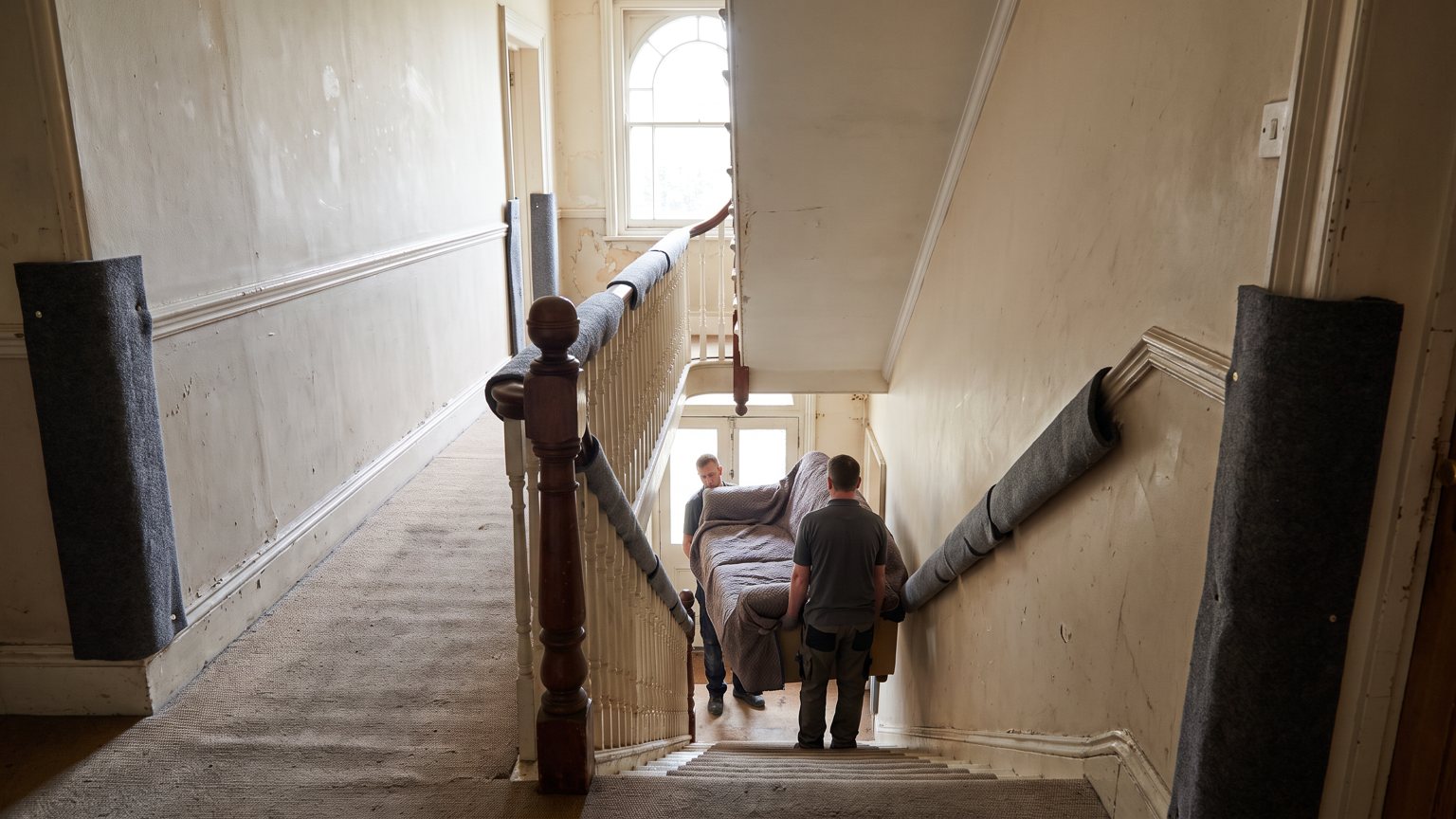
Ask anyone who has lived on the top floor of a converted townhouse and they will tell you the stairs were fine until moving day. Then the sofa that came up in pieces years ago refuses to go down, the wardrobe jams on the landing, and a neighbour needs to get past with their shopping. Moving out of an upper-floor flat with no lift is very manageable, but only if you plan for the building as well as your belongings.
Measure the route, not just the furniture
The question is never just “how big is the sofa?” but “how big is the tightest point it has to pass through?” Measure your flat’s front door, the width of each flight of stairs, the turn on every landing and the communal front door. Look out for low ceilings at the top of the stairs, handrails that stick out and radiators on landings.
Compare those figures with your largest items, including their diagonal depth. A piece that is technically narrower than the stairwell may still be impossible to turn on a tight landing.
Take it apart where you can
Dismantling is often the difference between a smooth move and a stuck one. Bed frames, flat-pack wardrobes, shelving units and table legs can usually come apart. Some sofas have removable feet or arms. If in doubt, check the manufacturer’s instructions or ask your removals team to assess it.
- Bag and label screws and fittings, then tape the bag to the largest part of the item.
- Take photos as you dismantle, so reassembly is easier.
- Keep the tools you need in a box that travels with you, not in the van.
Look after the shared spaces
In a converted building, stairs and hallways belong to everyone. Damaged paintwork or a scuffed banister can cause friction with neighbours or the managing agent, and may affect your deposit. Protect corners and door frames, keep the stairs clear of loose boxes, and never leave items blocking a fire escape route.
Let neighbours know when you are moving. A short note through each door explaining the date and rough timings is courteous and often wins goodwill. If the building has a managing agent, check whether there are rules about moving times or protecting communal areas.
Pack for the stairs
Every box will be carried, often several flights, so pack with that in mind. Use smaller boxes for heavy items such as books and crockery, and keep each one to a weight that can be carried comfortably on stairs. Tape the bottoms firmly and avoid overfilling. Put a clear label on the top and side so boxes can be stacked by room at the other end without lots of shuffling.
When to bring in a team
A long stair carry is hard physical work and the risk of injury or damage rises with every flight. This is where people who move flats every week can help. In Plymouth, where many flats are in converted Victorian and Edwardian terraces with narrow communal stairs, Two Man Removals carries out flat moves across the city, from areas such as Mutley, Greenbank and Stoke to the Barbican and Plymstock.
Their flat removals in Plymouth service covers stair carries with no lift, dismantling and reassembly, and furniture protection with blankets and corner guards through tight spaces. They also offer mornings, evenings and weekends, which can help when you need to fit around neighbours or a building’s preferred moving times. The company is a cooperative of three small independent businesses based in the city, and its crews are never subcontracted.
Timing the day
Allow more time than you would for a house of the same size, because each trip up and down the stairs adds up. Start with the largest items so the route is clear, and keep a small space by the door for things that must travel with you. If parking outside the building is limited, find out in advance where the van can stop and how far it is to the communal entrance.
A top-floor flat with a view is worth the climb most days of the year. With a measured route, dismantled furniture, protected stairwells and a well-planned day, moving out of one needn’t be the ordeal people expect.